



I’ll be honest with you. When I first heard about businesses switching to solar in Karachi, I thought it was just another environmental trend that would fade away. But after speaking with dozens of business owners and analyzing real cost data, I realized something important—this isn’t about being green. It’s about survival.
Karachi businesses are facing an electricity crisis that’s quietly destroying profit margins. I’ve met factory owners who’ve seen their monthly electricity bills jump from ₨500,000 to over ₨1,200,000 in just three years. Restaurants are forced to close during peak hours because of load shedding. Warehouses pay more for electricity than rent.
And yet, these same businesses are now installing commercial solar systems and seeing their energy costs drop by 60-80% within the first year.
Today, I’m breaking down exactly why businesses across Karachi—from small offices to large manufacturing units—are switching to solar energy. These aren’t marketing promises. These are real numbers from real businesses.
Why Are Businesses in Karachi Switching to Solar?
Businesses in Karachi are switching to solar primarily to combat rising electricity costs, eliminate load shedding disruptions, and achieve energy independence. With commercial electricity rates exceeding ₨65 per unit during peak hours and frequent power outages, solar systems deliver immediate cost savings and operational stability while providing strong return on investment within 3-5 years.
Let me walk you through the specific reasons driving this massive shift.
Rising Electricity Costs Are Hurting Businesses
Here’s the uncomfortable truth: electricity prices in Pakistan have increased over 300% in the past decade. Commercial users face the highest rates—often paying ₨50-₨70 per unit during peak hours.
I spoke with Ahmed, who runs a textile factory in SITE area. His monthly electricity bill was ₨2.8 million last summer. “We were spending more on electricity than raw materials some months,” he told me. “The profit margins just disappeared.”
The Pakistan Energy Commission reports that industrial electricity tariffs increased by 42% between 2020 and 2023 alone. That’s not a gradual increase you can adjust to—that’s a shock to your business model.
And it’s getting worse. Government subsidies continue shrinking. Capacity charges keep rising. Fuel adjustment charges appear seemingly at random. Businesses can’t plan budgets when energy costs fluctuate this wildly.
Solar energy offers something revolutionary: predictable costs. Once you install a commercial solar system, your electricity generation cost becomes fixed. The sun doesn’t send invoices with surprise charges.
Solar Energy Cuts Monthly Business Expenses Dramatically
Let’s talk actual numbers because that’s what matters to business owners.
A typical commercial solar system in Karachi costs approximately ₨15-₨25 million for a 100kW installation. That sounds expensive until you understand the savings.
That same 100kW system generates roughly 400-450 units daily in Karachi’s sunshine. At commercial electricity rates of ₨55 per unit, you’re saving ₨22,000-₨25,000 per day. That’s ₨600,000-₨750,000 monthly.
Do the math. Your payback period is typically 3-4 years. After that, you’re generating nearly free electricity for the next 20+ years.
I’ve reviewed cost analyses from businesses across different sectors:
- Manufacturing facilities with 200kW systems report saving ₨1.2-1.5 million monthly. Their investment pays back in less than 4 years.
- Office buildings with 50kW installations save ₨300,000-400,000 monthly on air conditioning and lighting alone.
- Retail stores and restaurants using 25-30kW systems cut electricity expenses by 70-80%, redirecting those funds toward business growth instead of utility bills.
The savings aren’t theoretical. They show up immediately in your monthly expenses. One warehouse owner showed me his bills—before solar: ₨850,000 monthly. After solar: ₨180,000. Same operations, same square footage, different energy source.
Net Metering Makes Commercial Solar Even More Profitable
Here’s something many business owners don’t understand initially: net metering transforms solar from just cost savings to actual revenue generation.
Net metering allows you to export excess solar electricity back to the grid and receive credits against your bill. When your solar system produces more electricity than you’re using—which happens frequently during business hours when sunshine is strongest—that extra energy doesn’t go to waste.
The process works simply. Your solar system generates 450 units during the day. Your business uses 300 units. The extra 150 units flow back to the grid. K-Electric credits your account for those units at the same rate you’d pay to buy them.
For Karachi businesses, this is game-changing. Commercial operations often have lower electricity demand during peak sunshine hours and higher demand in evenings. Net metering balances this perfectly.
I examined net metering data from several commercial installations. Businesses with properly sized systems routinely see their electricity bills drop to zero during high-sunshine months. Some even accumulate credits that offset usage during lower-production winter months.
The National Electric Power Regulatory Authority (NEPRA) currently supports net metering for commercial users up to 1 MW. The policy framework is stable, and the application process, while bureaucratic, is straightforward.
If you’re considering solar for your business, understanding net metering isn’t optional—it’s essential to maximizing your return on investment.
Solar Provides Energy Independence During Load Shedding
Let’s address the elephant in the room: load shedding.
Karachi experiences less load shedding than other Pakistani cities, but it still happens. And for businesses, even one hour of unplanned power outage can mean thousands in lost revenue.
Restaurants lose customers who won’t wait in hot dining areas. Factories miss production deadlines. Retail stores lose point-of-sale capability. Cold storage facilities risk inventory spoilage.
Most businesses solve this with generators. But generator operation costs ₨40-₨60 per unit when you factor in diesel prices, maintenance, and equipment depreciation. You’re paying premium rates for backup power.
Solar systems paired with battery storage provide clean, silent, cost-effective backup power. Modern commercial battery systems can power essential operations for 4-8 hours during outages.
I visited a pharmaceutical distribution center in Korangi that installed a 75kW solar system with battery backup. “We haven’t run our generator in eight months,” the operations manager told me. “The batteries handle any outages automatically. No noise, no diesel smell, no panic.”
Even without batteries, solar systems reduce your exposure to load shedding. Your peak electricity demand often coincides with peak sunshine. By generating your own power during business hours, you’re less vulnerable to grid failures.
Energy independence isn’t just about avoiding outages. It’s about not being at the mercy of utility companies, government policies, or fuel price fluctuations. That peace of mind has real business value.
Environmental and Brand Image Benefits for Businesses
I’ll admit—this isn’t the primary reason most Karachi businesses install solar. But it’s becoming increasingly important.
Corporate sustainability matters now. International buyers, especially in Europe and North America, increasingly prefer suppliers with demonstrated environmental commitments. If you’re in manufacturing or export, solar installation can literally help you win contracts.
I spoke with a garment manufacturer who supplies major European brands. “Two of our biggest clients now require sustainability reporting,” he explained. “Having solar panels on our roof makes those conversations much easier.”
Local consumers are also paying attention. Restaurants and retail businesses that promote their solar installations attract environmentally conscious customers. It’s subtle but real marketing value.
There are also genuine environmental benefits. A typical 100kW commercial solar system eliminates approximately 150 tons of CO2 emissions annually—equivalent to planting about 6,000 trees. For businesses concerned about their carbon footprint, solar delivers measurable impact.
But let’s be realistic. Most business owners I’ve met switch to solar for financial reasons first. The environmental and branding benefits are welcome bonuses, not primary drivers. And that’s perfectly fine. Sometimes doing the right thing environmentally also happens to be the smart financial decision.
Speaking of smart decisions, understanding the science behind solar energy can help you appreciate why this technology works so well in Karachi’s climate. You might enjoy learning some solar energy fun facts you didn’t know about that explain why solar is so effective in our region.
Which Businesses Benefit Most from Solar in Karachi?
Businesses switching to solar, but not every business is an ideal candidate for solar, so let me be direct about who benefits most:
- Manufacturing and industrial facilities are the absolute best fit. High daytime electricity consumption, large roof space, and consistent operational hours mean maximum solar utilization. Textile units, food processing plants, and light manufacturing see the fastest ROI.
- Warehouses and cold storage facilities run continuously and have extensive roof areas perfect for solar installation. Their electricity consumption patterns align well with solar production, especially when combined with battery systems.
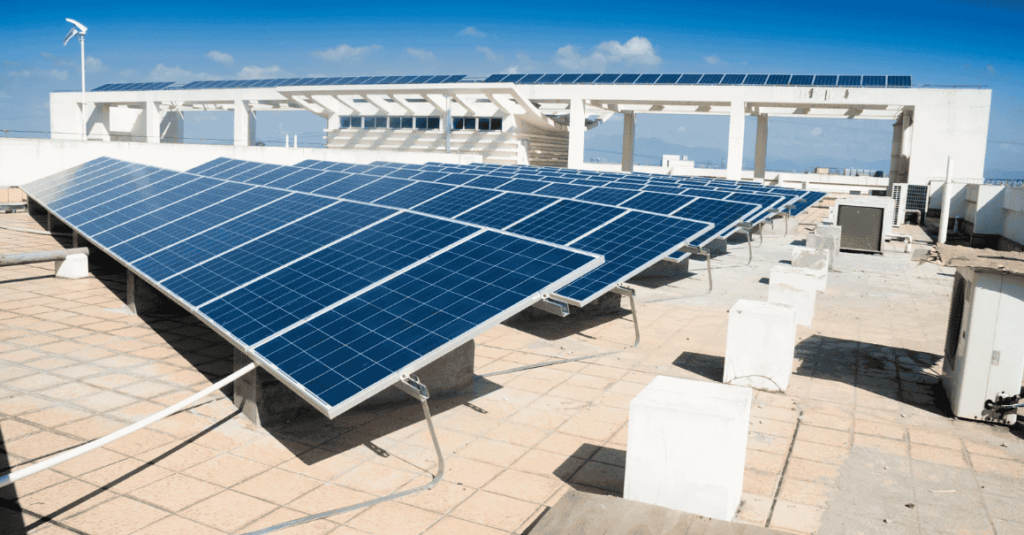
- Office buildings with significant air conditioning loads during business hours achieve excellent results. A 10-story office building can easily accommodate a 150-200kW rooftop system.
- Retail stores and restaurants benefit despite smaller installations. Their operating hours coincide with sunshine, maximizing self-consumption without needing expensive battery storage.
- Hotels and hospitality businesses with high electricity demands for HVAC, kitchens, and lighting see substantial savings. Rooftop space is usually available, and the environmental messaging enhances their brand.
- Educational institutions are increasingly adopting solar. Schools and universities have large buildings, predictable daytime electricity use, and long-term ownership horizons that make the payback period irrelevant.
Businesses that struggle with solar adoption typically have these characteristics: rented premises (landlord-tenant coordination issues), very small operations without adequate roof space, or 24-hour operations that would require expensive battery systems.
But for the vast majority of Karachi businesses, especially those with daytime operations and owned premises, solar makes compelling financial sense.
The Real Obstacles (Nobody Talks About)
I need to address the challenges because pretending they don’t exist would be dishonest.
Initial capital investment remains the biggest barrier. ₨15-25 million isn’t pocket change for most businesses, especially SMEs. Financing options exist through banks and leasing companies, but they’re not as accessible as they should be.
Installation complexity varies significantly. Structural assessments, grid connections, net metering applications, and NEPRA approvals create bureaucratic hurdles. Finding experienced, reliable installers in Karachi requires careful vetting.
Quality concerns are legitimate. The market has both excellent solar companies and questionable operators using substandard components. A poorly installed system underperforms, creates maintenance headaches, and fails to deliver promised savings.
Space constraints affect some businesses. Not every building has sufficient unshaded roof area. Structural reinforcement might be necessary for older buildings, adding costs.
But here’s what I’ve learned: businesses that work with knowledgeable solar providers navigate these obstacles successfully. The challenge isn’t insurmountable—it’s about having the right information and guidance.
What the Next 5 Years Look Like
Based on current trends and conversations with industry experts, I expect commercial solar adoption in Karachi to accelerate dramatically.
Electricity prices will continue rising—that’s not speculation, it’s confirmed policy direction. Every tariff increase makes the solar business case stronger.
Battery technology is improving while costs decline. Within 3-5 years, commercial battery systems will be affordable enough for widespread adoption, solving the load shedding backup problem completely.
Government incentives may expand. The current administration recognizes that renewable energy adoption helps Pakistan’s entire economy by reducing fossil fuel imports and foreign exchange pressure.
Most importantly, the businesses that install solar now will have massive competitive advantages over those that delay. Lower operating costs, energy security, and environmental credentials become increasingly valuable as markets evolve.
The question isn’t whether your business should consider solar. The question is whether you can afford to wait while your competitors cut costs and gain advantages.
Conclusion: The Competitive Advantage Is Real
I started this article skeptical and finished convinced. The businesses switching to solar in Karachi aren’t chasing trends—they’re making hard-headed financial decisions based on clear mathematics.
When your monthly electricity bill represents 15-25% of operating costs, and you can eliminate 60-80% of that expense with a 3-4 year payback, the decision becomes obvious. When load shedding threatens operations and generators cost more than solar, the choice is clear.
The businesses I’ve spoken with consistently say the same thing: they wish they’d installed solar earlier. Not one regrets the investment. Several are already expanding their systems.
Karachi’s climate provides 8-9 hours of productive sunshine daily. We’re literally sitting under one of the world’s best solar resources while importing expensive fossil fuels to generate electricity. The irony would be funny if it weren’t costing businesses millions.
So here’s my question for you: what’s stopping your business from exploring solar? Is it initial cost concerns? Lack of information? Uncertainty about ROI? Whatever the hesitation, it’s worth investigating seriously.
The energy landscape is changing. The businesses that adapt now will lead their industries tomorrow.
Ready to Explore Commercial Solar for Your Business?
At JS Technology, we help Karachi businesses assess solar viability, understand costs and savings, and implement comprehensive energy solutions, and help businesses switch to solar. Whether you’re running a factory, office, warehouse, or retail operation, we’ll provide an honest analysis of whether solar makes sense for your specific situation.
Contact us today for a no-obligation consultation. Let’s discuss how solar energy can reduce your operating costs and future-proof your business.
FAQs: Solar for Businesses in Karachi
Q1: Why are businesses in Karachi switching to solar energy?
Businesses are switching to solar primarily due to rising electricity costs (₨50-₨70 per unit commercially), frequent load shedding disruptions, and the opportunity to reduce energy expenses by 60-80%. Solar systems deliver predictable costs, energy independence, and strong ROI within 3-5 years while protecting businesses from unpredictable tariff increases.
Q2: Is solar energy profitable for businesses in Karachi?
Yes, commercial solar is highly profitable in Karachi. A typical 100kW system costs ₨15-25 million but saves ₨600,000-750,000 monthly, delivering full payback in 3-4 years. After payback, businesses generate nearly free electricity for 20+ years, making solar one of the most profitable long-term investments available.
Q3: How much can a business save with solar power?
Savings depend on electricity consumption and system size. Manufacturing facilities with 200kW systems typically save ₨1.2-1.5 million monthly. Office buildings with 50kW installations save ₨300,000-400,000 monthly. Most businesses reduce electricity costs by 60-80% immediately after installation, with savings increasing as grid tariffs rise.
Q4: What is the payback period for commercial solar systems?
Commercial solar systems in Karachi typically achieve payback within 3-5 years, depending on electricity consumption patterns, system size, and financing structure. Businesses with high daytime consumption and net metering see faster payback periods, often under 3 years. After payback, systems generate profit for 20-25 additional years.
Q5: Does net metering apply to commercial solar systems in Karachi?
Yes, NEPRA allows net metering for commercial installations up to 1 MW. Businesses can export excess solar generation back to the grid and receive credits at the same rate they pay for electricity. This maximizes ROI by ensuring no solar energy is wasted, even when generation exceeds consumption.
Q6: Which types of businesses benefit most from solar energy?
Manufacturing facilities, warehouses, cold storage, office buildings, retail stores, restaurants, and hotels benefit most due to high daytime electricity consumption and adequate roof space. Businesses operating primarily during sunshine hours with owned premises see the strongest financial returns and fastest payback periods.
Q7: Is solar a good investment for factories and warehouses?
Absolutely. Factories and warehouses are ideal for solar due to large roof areas, high electricity consumption, consistent daytime operations, and significant air conditioning or refrigeration loads. Industrial facilities typically achieve the fastest ROI, often under 3 years, with savings exceeding ₨1 million monthly for medium-sized installations.





